
Yes, it’s been aeons but I’m back! This time with a difference. Forthwith my reviews will be in the audio visual spectrum, published here should there be interest. Here is my review of Star Trek Picard.
Yes, it’s been aeons but I’m back! This time with a difference. Forthwith my reviews will be in the audio visual spectrum, published here should there be interest. Here is my review of Star Trek Picard.
Here is my new song Roadwave, a mix of rock, djent, prog and synthwave. It features the vocaloid Marie Ork. Like/comment/subscribe on YouTube. It’s a movie of sorts so it qualifies for this blog plus it’s my blog, hahahaha.

Doom guy had just slaughtered a battalion of hell. They had stood between him and a passageway, hewn into the ancient rock. Something was down there and he had to find out. Hundreds of imps, barons, cacodemons and Arachnotrons lay eviscerated before him. He stepped over their fresh corpses to investigate whatever was beneath. The passageway led to a pit under open sky with three arched chambers at the end of which were doors of gold, embossed with unspeakable imagery of things that shouldn’t have been and couldn’t be unseen. Doom guy was aware that the sky had become darker and notably stormier as he crossed the bridge to the middle chamber which stood over a pool of lava. He was mindful to occasionally dodge out of the way of the molten rock that was spat from below. Doom guy smashed the golden door down with the rage induced slam of his fists. On the other side was a winding corridor with a filigree of stone that formed the path over a river of more lava. Doom guy made his way through, turning this way and that as the corridor snaked at sharp 90 degree angles. On the walls were occult symbols, perhaps some invocation for one of the abominations represented on the doors.
The sky had become yet more thunderous, its former red hue turning to a dark purple. The corridor led to a room whereupon Doom guy encountered another door. But this was no ordinary door. It was completely flat, lacking in any kind of discernible depth. He had never seen anything like it. On what counted for its surface, there was a whirlpool of stars, but he wasn’t sure whether these were the normal stars of our universe. The way they danced about and were aligned suggested the image of a tornado of lost souls or perhaps willing participants, committed to witchery, to some abominable and depraved outcome. Doom guy put his hand on this surface yet to his surprise it went through rather than resting on it. He retracted his arm and saw that it was intact. Maybe it was a portal of some kind like the ones he was used to on Phobos and Deimos? Maybe it was a way out of the unending hell to which he had been condemned? If it was death or maybe some other world across the divide, it had to be better than this. With these ruminations, Doom guy suddenly felt very tired. He was weary of it all and whatever this was, it could be an escape from hell. So Doom guy stepped through.
Doom guy materialised in the middle of a lawn lined with oak trees in the height of verdant spring. The turquoise sky was illuminated by a ball of white hot flame, the name of which eluded him. He had not felt its rays for aeons. Through the morning haze he espied a mansion and nearby was a lake. A bemused grunt came unbidden to him. This was…different. And it seemed like he was out of time, everything appeared distinctly…antiquated. Three comely maids in long white dresses were running towards him. His first instinct was to reach for his shotgun but he noticed all his weapons had vanished. “Oh hello”, said one of the three ladies. She had luxuriant, flowing blonde locks and a porcelain features. “My name is Elizabeth and these are my friends, Kitty and Caroline”. “Meow”, Kitty purred. She was the ying to Lizzie’s yang. Although she was clearly in her early twenties she had salt and pepper hair and a sultrier appearance. “Pleased to make your acquaintance” said the brunette Caroline. “Would you like to join us for tea?” asked Lizzie. Doom guy struggled to find words. Something cracked in him. After so many years of torment, hatred and violence, after all the horrors he had witnessed and the brutality he had been forced to commit just to survive against pure evil, he was suddenly in an entirely new existence…an existence which knew nothing of hell, which was entirely innocent of it. Seeing these three lovely lasses with their sweet smiles standing before him, the light from the sun shining upon them yet seemingly accentuated by their inner radiance, brought a manly tear to his eye. Doom guy had forgotten to speak because he hadn’t been in contact with humans for a long time. Yet somehow he croaked out a word he knew in a language that was distant to him. “Yes” he said. “Oh wonderful” said Lizzie, “William and Charles will be ever so delighted to meet you”. “Come, this way”.
Doom guy was holding back the urge to cry, but he couldn’t contain his feelings. He fell to his knees, removing his armour until he was naked as the day he was born and wept with joy. It was finally over but he was conflicted. Was he human anymore after everything he had done? Could he really re-join the human race after what he had been compelled to become? “Oh whatever is the matter asked Lizzie”, a concerned and puzzled look on her face that was mirrored by her compatriots. Doom guy remembered more words of the lost tongue. “I’m, I’m sorry, I just need a minute, it’s, it’s so beautiful here”. “Well we’ll need to get you into some clothes, it would be ever so improper for you to join our tea party in such a state!” said Lizzie. “And we must feed and bathe you too, you are so filthy!” said Kitty. “And you look famished!” added Caroline.
Taking a vulnerable Doom guy’s hands, the three maidens led him into their mansion whereupon he was washed, purified of the blood and dirt of hell and fitted out in a dapper suit. At the tea party on a dinky little chair much too small for him, Doom guy sat. Listening to the endless pleasantries and frivolities exchanged, Doom guy became bored, retreating into memories of hell. He could not relate to them; they knew not of the world where he had been. Innocent lambs, completely oblivious to a door that led to somewhere which was the antithesis of their universe. But then again, had not that door vanished whence upon he had appeared? How did this work again?
Doom guy’s train of thought was interrupted when Lizzie raised her voice at Kitty: “Don’t be so catty, Kitty!” said Lizzie. They all looked in turn at Doom guy. “You must pardon my manners… Kitty has reminded us that we have made an inexcusable transgression, we forgot to ask your name…Tell me, what is your name?” asked Lizzie with a note of sympathy. “Ummm…” said Doom guy. He couldn’t remember his name, the only words that came to him were doom as he had been damned for so long and guy, as he was a macho man. My name is… “Mr. Guy, Mr. D. Guy”. After nominating himself, he felt something shift in him, as if he had an identity, a sense of self he had for so long suppressed. “Oh heavens what an unusual name” chimed Lizzie. “Mr. D. Guy???” “Oh don’t be so rude, Lizzie” said Caroline before asking: “Would you care for some crumpets Mr. Guy?” “Uhhh…yes?” Mr. Guy struggled to recall that he was in polite company and should say the magic word…”um…please?” Caroline past some top biscuit to Mr. Guy who looked mildly bemused at what he beheld before snacking on one. Crumbs spilled on his trousers as his hosts looked on, a little bit embarrassed at his lack of etiquette. Lizzie broke the silence. “Well Mr. Guy, we were just wondering whether you have a beau whom you would like to bring to our tea party?” “B- O?” Mr. Guy sounded the words in total befuddlement. “A wife, a fiancée, a companion?” said Charles. “Oh…ah…no, I haven’t met anyone like that.” “Well we have the perfect match for you” said Caroline. “Yes, said Lizzie, we must introduce you to her. Maybe I should fetch her from the garden?” asked Kitty. “No” said Caroline, “I think she’ll be riding the horses, why not try the stables? And do mind your step with the haha.” “Your word is my command my lady” replied Kitty.
Kitty returned a few minutes with what appeared to be a female but which certainly wasn’t human. “Mr. Guy”, Kitty said, “I’d like to introduce you to Ms. Impse, second daughter of Count Impse of the Kingdom of Impsania. She has joined us here in our pastoral paradise for the year to learn the customs of high society and to find a husband on the command of her lord father.” Mr. Guy’s heart pounded while his stomach fluttered with the beat of butterfly wings. As he looked into the black pits of her eyes, he felt he had known this goddess for a thousand years. Or that they had met once many moons ago. But it didn’t matter, all he knew was that he was madly in love. Ms. Impse wore a white, floral patterned bodice and a long white skirt. She was tall and aquiline and moved towards him with an elegant grace. She sat next to Mr. Guy and placed his hand in her brown, leathery claws. Caroline asked “Would you care for some tart?” Mr. Guy? “Uhhh, yeah, please…thank you.” replied Mr. Guy.” As Caroline passed some delicious tart to Mr. Guy, Ms. Impse nudged him in the ribs. “Oh my dear, how sweet you look” she said, her face contorted in a wide smile that showed off her sharp fangs. Mr. Guy looked down, suddenly embarrassed at himself, at this unexpected lavishing of female attention. He stuttered as he sought to find words to express the warmth of his feelings in Hugh Grant style. “W-well, Ms. Impse, y-y-you look, well what I mean to say is that”… Mr Guy took a breath and started again. “What I mean to say is that you look absolutely stunning and uh…” It dawned on Mr Guy that offering a small token of affection would impress his new “beau”. “Um…would you care for some of my tart and tea?” Ms. Impse chuckled, “Oh pshaw, you snake charmer, you do know a way to a girl’s heart!” With that, Ms. Impse betook of Mr. Guy’s tart and tea, sipping on the latter with an impish grin as she stared ravenously at Mr. Guy. “Isn’t this ever so wonderful” exclaimed Lizzie, “oh you two are made for each other!” “I concur” said Charles. “Hear hear” said William. “You simply must be wed on the morrow” said Kitty. “Oh and imagine your children, won’t they be so beautiful?” said Caroline. Ms. Impse and Mr. Guy blushed in unison. Oh truly they were two peas in a pod! “Well I must declare, that you two are married then on the morrow”, said Lizzie! “Who agrees?” “We all agree” they said. Ms. Impse looked up adoringly at Mr. Guy, asking him with her rows of eyes if he would only say the words and in that moment he found them. “Will you…marry me?” He asked. “Oh yes, upon all the moons of Jupiter and for the fire of a thousand suns, yes!” cried Ms. Impse. “Wonderful” said Lizzie. “Then it is done, we shall have a wedding tomorrow in the chapel of papa’s mansion.” “Delightful” said Kitty. “Outstanding” added Charles. “Magnificent” shouted William. “Purrfect” Kitty purred. “Exemplary” contributed Caroline.
On the morrow, bride Impse walked up the aisle of the chapel. As her wedding dress trailed the stone floor, hand maidens threw black roses upon its burgundy marble surface. From the balcony cherub like figures sang hymns of praise and devotion to some far removed deity. Mr. Guy was arrayed in the finest formal attire money could buy. As he reached the top of the altar, he took bride Impse’s claws in his hands. The priest asked the perfunctory question if they would marry and both of them said yes before getting the thumbs up to enter a long and heavily involved kiss. Mr. Guy had forgotten what it was like to be kissed. He felt loved and wanted, most importantly he felt a warmth he had not known in so many years. He had arrived, he was home. The 500 or so gathered in the chapel clapped. In the front row Lizzie wiped a tear from her eyes as she joyously looked on. Further behind, Mr. Guy saw Kitty and Caroline hug each other and Charles and William gave each other congratulatory high fives.
A party was held in the great hall which was bathed in ochre light from fireplaces lining the walls and a large chandelier. Mr. Guy and Ms. Impse made the rounds talking to various guests. Mr. Guy was privy to the ribald witticisms, japes and capers of William and Charles as they indulged in excessive amounts of libations that would make Bacchus blush. Violins and pan pipes played melodies from some undisclosed and quickly forgotten location. Perhaps it was from the rafters or one of the corners of the hall thought Mr. Guy. Their sweet song wafted on the ethereal night air as the guests danced, indulging in the mirth of the occasion and dancing like the satyrs they were beneath all those good intentions, repressed drives and practiced politeness. It was late that night when Lizzie had a devilish notion. Announcing her scheme to the five hundred or so guests she said: “I have a fiendish idea for fun, why don’t we all go skinny dipping in the lake?” “What a marvellous idea” shouted Kitty. “Oh I do concur” Charles said with a glint in his eye. “Oooohh—eeerrrr oooooohhhh mmyyyyyyy” exclaimed William. Ms. Impse and Mr. Guy looked at each other pensively but had no choice but to go along when the guests uproariously bellowed their approval of huzzahs and hurrahs that were deafening to the ear. And so they made their way to the lake. In all the Bacchanalian confusion they became separated and lost sight of each other. Mr. Guy was lounging in the shallow depths whereupon he witnessed a momentary bubbling. “Oh that was me, sorry said Charles”. “Oh how dirty of you!” exclaimed Kitty. “I am shocked and deeply offended” quipped Caroline. William joined in the repartee: “Although…” he began, “it conjures an idea…imagine a bathhouse like those of Ancient Greece, one which bubbles with the power of one’s own flatulence?” “Don’t be silly” said Lizzie, how on earth could that be sustainable much less desirable? “Well obviously it wouldn’t be powered by the bum but by a similar process…hmmm bye the bye, I am a man of science, I should put my mind to building such a contraption.” “Something that would shame Uranus” Mr. Guy joked. They looked at him bewildered. The silence broke like the gentle breeze on the night air when Charles finally understood and said: “don’t be silly, Uranus is god of the skies, if anything such a wondrous device would make Poseidon blush!” They all laughed, with the exception of Mr. Guy, who was now the butt of the joke, in light of his lack of formal education in the classics. “Hahahahah, oh such grand wit” said Lizzie.
Mr. Guy felt somewhat isolated in his lack of sophistication so he decided to make an exit. As he emerged from the lake he finally saw Ms. Impse standing nearby. Her body glistened in the pale moon light. She had an a toned and athletic frame which she held with a demure countenance that belied a certain repressed sleaziness, waiting to break out on their honeymoon. Though, perhaps this was the night of the honey moon…Mr Guy thought. After all, they were covered in the silver aqua glow of the celestial globe in all its glory that night. Ms. Impse smiled coquettishly at him. Mr Guy returned the gesture. They held hands and slowly made their way from the others. “I want to show you something” Ms. Impse said. “I think you’ve shown me everything” Mr Guy joked. “Oh, no, not at all. I want to show you the horses, we can ride them.” “Oh…” said Mr. Guy, “I can’t say nay to that.” “Then quit horsin’ around” replied Ms. Impse. They arrived at the stables. “These are my racing stallions” Ms. Impse said. “They are truly fine beasts” Mr. Guy said as he patted one on the nose. And so they mounted Ms. Impse’s horses. As the horses gently trotted through the glade Ms. Impse asked Mr. Guy: “Do you ever feel like you’re alone in this world my sweet pea, like you don’t belong with the others?” Mr. Guy responded “I have never felt less lonely than with you my cupcake but I will admit, I feel out of place in light of my…difficult past”. Ms. Impse reflected: “I myself also, know the sting of isolation my peach. I feel sometimes that I am not…how shall I put it…refined enough to associate with my peers, but I do love them so and they me also”. “Your happiness is all that matters to me my sugar plum” Mr. Guy said. Ms. Impse, was pensive for a moment, lost in thought about the future, then said: “Perhaps then we should start a family my honey bucket…we’d never have to worry about being apart again with a link between us?” “Yes I would like that my chickadee” replied Mr. Guy. He paused…he thought he saw a rabbit hop through the grass and it brought to mind feelings of love in the past but he couldn’t quite place them. He remembered a name yet he couldn’t form the sounds to say it as he saw daisies in among the grass. When he turned to look at Ms. Impse he recalled that he had never had a female companion before and mayhaps that had been the source of all his unquenchable rage. But such was all ancient history now. At that moment, his horse startled by the bunny, reared and he fell on his back. Fortunately, the grass was softer than a plush velure carpet and he sunk into its embrace. Ms. Impse’s horse was likewise startled and went up on its hind legs. She tumbled into Mr Guy’s arms. They could no longer help themselves. That night they finally submitted to their throbbing biological urges and consummated their marriage.
A few months later Ms. Impse discovered to her utmost joy that she was with child and in nine months there lay Ms. Impse cradling a new being in the bedroom as the saccharine rays of a morning dawn filtered in through the windows. Mr. Guy was at her side as Lizzie, Charles, Kitty, William, Caroline and their acquaintances stood smiling bearing their respective gifts. As Mr. Guy and Ms. Impse looked adoringly upon the hybrid progeny of that unforgettable night of passion betwixt man and imp, a creature with eight pit black eyes, sharp incisors, snowflake human skin and misshapen head, Lizzie said: “A new star is born, he will be the light to guide us in days of darkness, he will be your salvation and ours and yet he is nameless…as what shall he be baptised Mr. Guy? With a quizzical look Mr. Guy stared into Ms. Impse’s eyes and nodding once he had found the answer, Mr. Guy announced to his friends: “I baptise thee….Gerald”.
Fin.

Daniel Abraham and Ty Franck’s Leviathan Wakes (2011), penned under the pseudonym James S.A. Corey, is the Hugo award winning first novel in The Expanse series. This is must read science fiction. It’s page turning and easy to read. The plot is easy to follow but needs a little bit of explanation for the points that follow so I’ll do a brief summary here.
Set two hundred years from now, Leviathan Wakes depicts a future in which humanity has colonised most of the solar system with colonies on the Moon, Mars and the Asteroid Belt. Furthermore, the human species is beginning to evolve according to different paths, subject to their environments. Thus, it has become split into three factions, the Earthers, the Martians and the Belters. The Earthers are the most economically privileged and boast a formidable, if not dominant military presence in the solar system. The Martians are their nearest rivals and seek independence from Earth. The Belters are the worst off; physically frail and unable to cope with Earth gravity, they have adapted to a zero g environment in the asteroid belt. They are economically exploited and resent both the Martians and Earthers. Furthermore, they have formed an organisation called the Outer Planet’s Association (OPA) to defend their interests.
The narrative focuses on the efforts of a former ice mining ship crew led by James Holden and a detective named Miller to locate the whereabouts of a woman named Julie Mao, the daughter of the CEO who runs a biotech company named Protogen. Later on, Holden, his crew and Miller discover that Mao is dead on Eros station and covered in an infectious substance. A false flag radiation attack is declared and people are herded into radiation shelters, where ironically, they are irradiated. As it transpires, the infectious substance is in fact an alien artefact known as the Protomolecule and radiation accelerates its growth. The ‘experiment’ on Eros is being conducted by Protogen under the supervision of Mao’s father. The Protomolecule, which was discovered on the Saturnian moon Phoebe was designed to attack and reprogram life on Earth 2.3 billion years ago and Protogen hope to harness its potential.

Now onto my reflections. One, genre: I like how the novel is positioned between hard sci fi and space opera. It’s not narratively restrained by the minutiae of technical details and the limitations of space travel/physics at our current level of technological development, yet there is enough information regarding thrust, simulated gravity and orbital vectors to give the world it depicts substance and realism. In fact, Corey has done something rather ingenious, he’s utilised the limits of hard science fiction conventions to create a kind of “necessity is the mother of invention” drive to his novel, thus rendering it more creative in scope. However, he does not become bound to them, which enables him to introduce wilder science fiction concepts like the Protomolecule and Epstein drive. Corey notes in the interview that forms the addendum to the book that it is straight up space opera and yes that is true, but it’s scaled down space opera, grounded in realism though not entirely beholden to it. One issue I have with space opera is that it can often fall down the rabbit hole into deus ex solutions, technobabble and tired clichéd stakes such as “the battle for the galaxy/universe/existence/everything”. Not so here. We have humans colonising the solar system, small and contained, but with existential stakes localised to the survival of our species. In this way it reminds me of Battlestar Galactica, another space opera with the same tightly defined stakes with regards to human survival. No wonder then that the TV adaptation has been touted as a successor to BSG, and a worthy one it is too that is faithful to the books.
Another genre Leviathan Wakes draws upon is noir. Miller, is a hard drinking, suicidal detective, determined to track down Julie. Such is his obsession with her that he begins imagining her giving him advice (on this note, I wonder if Miller suffers from mild schizophrenia?). The Miller chapters follow this kind of space detective/cyberpunk noir angle in that they’re gritty and rely on a mystery angle. Actually, in relation to this, the novel is structured along a ping pong transfer between Miller’s perspective and that of Holden’s. As Corey explains in the interview, Miller views information as something to be controlled and used for leverage or to achieve certain outcomes as in a game, whereas Holden perceives it as something to be disseminated freely regardless of the consequences, in keeping with an idealist spirit. Both perspectives have their flaws and advantages. The back and forth exchange between the Miller and Holden chapters creates a brisk narrative pace.
Two, politics: Leviathan Wakes images a model of current human political and social relations within a science fiction context such that we find many parallels with today, again another parallel with BSG. I think its exploration of corporate greed, sociopathy within corporate culture and the consequences entailed therein were very effectively explored through Protogen and the Protomolecule. Protogen are the main antagonist of the novel, even when we consider the alien particle they’re harvesting, as the particle merely operates on the basis of its programming whereas Protogen is run by humans who make conscious decisions to massacre 500,000 people on Eros. The main person involved in directing this experiment, Dresden, is your quintessential unethical corporate CEO, a kind of Patrick Bateman from the future, described as having “blue blood European good looks”, “a gym sculpted physique” and an “expensive haircut”. In keeping with his egotistical nature, he has created a science team in his own image by modifying their neural structure so that have become sociopaths themselves. The more practical rationale though is that he needs a team of scientists who have no ethical qualms about deliberately infecting a massive population base just to see what the Protomolecule does. I found this aspect of the book very interesting, as he notes that “they’re extremely curious high functioning sociopaths who “remain quite content” as long as they’re supplied with puzzles to solve and unlimited resources, though he does acknowledge there have been some issues. This kind of imagery is rather haunting but also intriguing regarding the psychological behaviour and neural mechanisms underlying sociopathic behaviour and how a corporation has decided to harness it, in a kind of parallel with the way they harness the Protomolecule, an alien artefact without conscience. This in turn reflects a tendency within capitalist culture to worship ruthless pragmatism and the repressed anxiety therein which is generated as a result. If you go into any corporate lobby, say one in a Goldman Sachs bank, there isn’t anything beyond surface aesthetic. In contrast to say feudalism (feudalism being the direct predecessor to capitalism), which though horribly authoritarian, did at least entertain principles of chivalry etc. through its artwork and literature, within the corporate psyche there is no higher ideal than the banal and superficial one of profit. Game theory and socially Darwinist logic constitute the bedrock discourse that influences human behaviour within these institutions and corporate culture more generally, all in the name of the relentless and single minded pursuit of maximising profit. I think Protogen reflects this insidious culture and how it comes more and more to envelope civil life, with the predominance of corporations and their infiltration into the governance of public institutions and systems. In this way, the Protomolecule could be seen as a metaphor for the assimilation of the civil state by corporate interests. The association between Protogen and the alien artifact suggest this. Even the first five letters of their names imply a link, Proto-gen and Proto-molecule.
Furthermore, Dreseden talks about humanity ascending to godhood (although he leaves out whether it will only apply to those who can afford it). He makes an interesting case for why the experiment was carried out and why he considers the sacrifice of so many lives acceptable, that is, until Miller shoots him. However, what Dresden serves to emphasise is the ego fuelled hubris of the corporate mentality shared by so many top level CEOs and business founders. The whole empire building, “I will be a sun god/emperor of the world” egoism is reflected in his dubious speech and moreover ties back with the sociopathic values of corporate culture and the social divisions imposed by neoliberal capitalism. The trans-humanist imagery evoked in his speech is vaguely off putting. It almost suggests the vision of a trans-humanist elite, irrevocably divorced from their own humanity, lacking in empathy, pure realisations of power and force. Of course we could identify another parallel in this with the current mind set of our own contemporary elites. Dresden justifies his actions when he states that humanity needs to ascend to another level by using the protomolecule if it wants to stand a chance against the aliens who created it.
Another interesting element are the Belters. These people are basically your subjugated proletariat in space. They have a strong sense of nationalism, perhaps ethno-nationalism and they really hate the Earthers and possibly to a lesser extent, the Martians. They are on the lowest rung of the economic totem pole but it’s suggested that they represent the future of humanity. This is implied in the following line: “Maybe that was why they were taxed to subsistence level. The bird was out of the cage, but you couldn’t let it stretch its wings too far or it might forget it belonged to you”. In this sense the Belter’s represent a kind of proletarian, “blessed are the meek for they shall inherit the stars” future, which explains why the powers that be on Earth and Mars want to hold them back, to milk them economically and suppress their political power. To my mind this echoes how the working classes are suppressed in modern “democracies” in case they take over the means of production and usher in truly democratic societies. The “future” in both instances is something that is delayed by corrupt conservatism and the desire to maintain the status quo. Not surprisingly, the Belters in being persecuted also have a nasty nationalist streak which again hints at how say, the economically subjugated in the U.S. voted for Trump or how many people from socially disadvantaged areas voted for Brexit because of their paranoia of immigrants. In both cases, economic subjugation fuels ethno-nationalism. In fact, persecution in general will do this, the Israeli-Palestinian situation being a case in point. And that’s what I like about this novel; it takes pre-existing social problems within the human race and extrapolates them as the “human diaspora”, in Corey’s words, begins to spread out. In the interview he mentions how humans bring their own internal baggage to the galaxy as a threat and how they are faced with alien threats such as the Protomolecule. Both in turn put the survival of the species in jeopardy and again this is a constant theme in the novel with the prospect of an apocalyptic war between Earth and Mars breaking out.
Finally, as regards political themes, in keeping with the novel’s American context of production, there is a lot of hero worship for the military, namely the Martian marines who can be read as an equivalent to the US marines. I didn’t mind this but as a European I found the worshipful tone somewhat puzzling. True, Lieutenant Kelly and his men sacrifice their lives for Holden and his crew, but it does point to an American cultural frame where the military is seen with an element of awe. The Martians are actually akin to the United States and Earth is almost like a decadent Europe. For example, Martian culture is highly self-reliant, Alex, a former Martian navy pilot, has an affected southern drawl and they invest heavily in their military. Earth could be seen as a decadent corporate state, stagnant and corrupt, which is reflected in the fact that their technology is slightly behind Mars. There isn’t too much detail, politically, on both powers other than that they hate each other, though I expect this will be explored to a greater extent in the subsequent books in the series. The only thing I can never see happening are Mormons in space flying on an ark ship but I did enjoy the quirkiness of the idea.
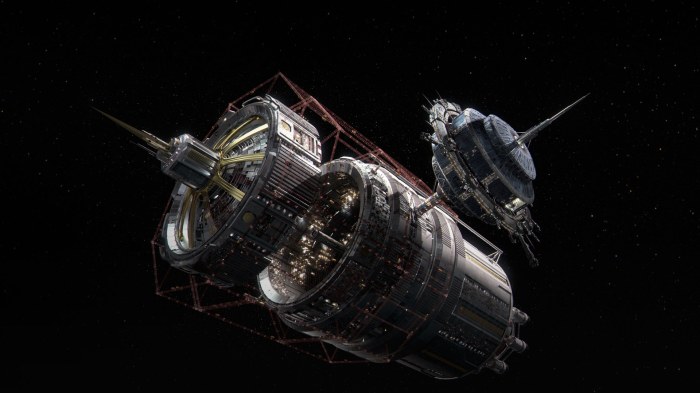
The science in the novel is never beholden to techno babble or magical solutions. The dog fights with the Rocinante are cool. The sections detailing the effects of radiation exposure on Miller and Holden are grimly fascinating and it’s clear the writers have done their research. Although they recover, they’ll be on meds for the rest of their lives and you really feel sorry for them because they’re never going to be fully 100% again after the physical horror they experience on Eros. They’re almost falling apart by the time they get back to the ship. The medical procedures they undergo to recover were really interesting, basically their blood is flushed out and they get massive dosages of chemicals to prevent cellular mutations from their damaged DNA. You get the sense Miller was worse affected but both characters have to suffer with the effects; there’s no Star Trek fix for them but they recover more or less and you kind of feel relieved for them once they return to the asylum of the ship.
Character-wise, Miller and Holden are the most developed with Amos occupying a generic, strongman/everyman role and Alex merely being a functional pilot. Naomi is somewhat more rounded but there’s not as much attention given to her. This might be a flaw of the novel in being written around two principle protagonists and it carries over a little bit into the TV show. With the exception of Miller there aren’t any characters that are actually likeable in the show, although Holden, as in the book, is essentially a space goofball; rather than being super competent or highly intelligent, he’s caught up for the ride and his idealism frequently gets him in trouble. In the book itself his proclivity for just releasing swathes of information to the public is frequently referenced in an arch way. I think it’s refreshing to have a main protagonist who isn’t actually that wise or intelligent. It’s cleverly written in that he’s not a Philip J. Fry but he’s far from being a Kirk or Picard either. He is simple minded in a naively idealistic way. Naomi by contrast is much more intelligent and capable and it’s pretty much emphasised in the book that he relies on her, almost completely to make decisions. Amos in the show, is a far better character than in the book. It’s emphasised that he’s not the smartest but in actuality he is quite intelligent. His ultra-macho philosophy (take note of the “churn” speech or his speech to Alex about protecting weaker people) might come across as gorilla-like, awkward and sometimes weird, but on the whole he’s capable member of the crew and grasps concepts quickly. He is ultra-violent but also a humourous figure to some extent, such as when on Tycho Station, Alex asks whether he lives in the bar/brothel as he always seems to be hanging around there (this happens after Amos randomly appears out of nowhere to punch Alex’s assailant).
In terms of things to criticise there’s very little to find. The only thing I would say is that the body horror of the Protomolecule is a little bit clichéd; it reminded me of The Thing or Deadspace. Perhaps something more original could have been tried but in such an over saturated genre that would be a hard, perhaps impossible thing to do. However, the descriptions of the rad shelters and vomit zombies did add to the atmosphere so it was hardly perfunctory horror either. In relation to this, what I found even more disturbing was the fact that Diogo and his friends decided to make “hardcore” dance tunes to the recorded screams of the victims on Eros. I guess this was their way of dealing with whatever PTSD they suffered. Some of the references to other sci fi works were a little forced and cheesy, such as Julie’s Dune reference (talk about being shoe horned in there).
In summation, this book is excellent. Its 550 or so pages will breeze along as you get sucked in. It also provides a lot to think about and the universe it depicts is simply put, cool! There’s an excellent mix of noir and space opera, the technical information provides realism, depth and world building, the politics are for the most part, well realised and the novel ultimately presents an appealing universe, one you want to savour and enjoy, rather than plough through, because it’s fresh and vibrant, not over-saturated nor too comfortable in its own skin. The characterisation could have a little more depth but ultimately this is a highly recommended read.
A difficult but rewarding and informative read. As I type this my mind is completely knackered due to poor sleep so this review is all over the place much like I am today. I started this book on the basis that I had bought it when I was 17 and never had the willpower, time or interest to read it until now. The catalyst for that was twofold; I had recently finished a science fiction novel by Peter F. Hamilton, “A Night Without Stars”, which details the overthrow of a decadent capitalist regime by vaguely communist forces. This sparked my interest in truly trying to understand the ideas behind communism. Secondly I had run out of stuff to read and had a week long wait to buy something else, so in the interim I began Capital in earnest with the intention of completing it.
First reflection…there is a hell of a lot of repetition in this book so if you find yourself drifting over detailed explanations of the commodity, as I did, then fear not because Marx repeats his explanations with example upon example to tease out the niceties of his theoretical concepts. The main theme I derived is this but it’s pretty much a bastardised version: say the capitalist runs a factory that produces bottles…well the workers produce 4 hours’ worth of bottles and are paid for these 4 hours to cover their subsistence, so they can exist to continue working. However, the next 4 hours are spent producing bottles to create surplus value for the capitalist, who uses the profits obtained through selling them in bulk as a commodity to invest in the increase of his capital by buying more factories etc. Marx calls this the “valorisation” of capital, which is the primary objective of capitalism, in that it exists to add value to itself.

The capitalist has to invest the revenue from production into the purchasing and maintenance of machinery, which Marx calls “constant capital” and also into the payment of the workers which he calls “variable capital”. Constant capital imparts value through production to the end commodity. Through every bit of use it wears down a little but transfers a portion of its value to the product. Variable capital are the workers and surplus value is derived from them through exploitation. The workers sell their labour as the only commodity they possess to the capitalist. The actual physical commodity produced through labour is sold at an exchange value higher than its actual production value and the factory owning capitalist thereby makes a profit. It’s something like that anyway, I felt a bit too dense to understand a lot of it and got bored quickly with the detailed explorations of theoretical points. Actually, in writing this paragraph I would have to raise a question; can constant capital produce surplus value? Marx would argue, I assume, that surplus value derives from a social relation between the capitalist and worker. Therefore, if one capitalist ran an entirely automated factory to produce surplus value, then other capitalists would do the same and there would be a market equilibrium with no surplus value; it is only by hiring workers to add to the value produced through their exploitation that surplus value can be achieved. Anyway who is going to operate and maintain the machines but lowly humans? And they need wages to buy products from other capitalists to make the merry wheel go round.
Perhaps the most interesting part of the book is Marx’s sustained analysis of working conditions in nineteenth-century England. The exploitation of women and children, the squalor in which the proletariat lived and the horrific abuses of power by the owners of factories/workhouses fully validate the old aphorism “socialism or barbarism”. The repeated mentioning of bread that was not bread, but instead a mix of chemicals, soot and maybe some crumbs as the staple food of the workhouse and factory employees is something that stuck in my mind. I think that although workers’ conditions are relatively improved compared to 150 years ago, the same wouldn’t hold true with regards to the outsourcing of menial labour to export processing zones in developing countries. Also the chickens are coming home to roost so to speak, with rollbacks on workers’ rights in the West under the neoliberal doctrine. Certainly, the rise of automation is going to leave a lot of people unemployed in the next century. The tired argument is that everyone should learn a STEM subject, whether they’re suited to it or not, as a passport to the ever dwindling “middle class” but the reality is that without some socialist measures, life could go back to the same kind of brutality and squalor documented by Marx. In the UK and US the ideological doctrine of neoliberalism has meant massive cuts to public services, in fact a concerted effort to dismantle them; just this week the committee of social mobility resigned, such is the neoliberal dogmatism of the Tories. It seems that a certain substrate of society, namely the elites supported by a portion of the electorate, want to impose a perfectly barbaric dystopia through artificial policies that go against a functioning civil society. This says a lot about their personality and character but it is equally a reflection of the tendencies within capitalist society and culture.

On this note, Marx does a good job of detailing the historical implementation of capitalism. He formulates his own version of Hegel’s dialectical materialism, namely historical materialism (indeed, a strong sense of Hegelian dialecticism runs throughout the work in a variety of theoretical formulations and observations). In the early parts of the book he discusses how ancient and feudal societies functioned and notes nascent forms of capitalism with respect to usury and limited mercantilism. In many cases commodity production, trade and currency existed but were not utilised in the specific manner that generated capitalist social relations. In this respect Marx distinguishes between the formal and real subsumption of labour under capital. If I understand it correctly, so take it with a large pinch of salt, in formal subsumption the capitalist draws upon an existing manufacturing base, outside of and prior to capitalism. Therefore, a group of hand weavers agree to work for the capitalist for a wage. Under real subsumption those same hand weavers are now the deskilled operators of sewing machines and any alternative arrangement for higher wages is inconceivable. It is not until a particular confluence of political and technological conditions that capitalism really begins to take off, initially in Italy in the sixteenth century. Marx highlights its contrived enforcement in England and elsewhere in Europe, with the mass expropriation of self-sufficient farm labourers from their own land and the dismantlement/succession of the guilds by industrial production, which served to devalue the work of craftsmen. These historical developments, many of which were rooted in governmental policy, disenfranchised the proletariat, compelling them to participate in the emergent capitalist system for their survival. Without the means for self-sufficiency they were forced to sell their labour. In this sense Marx consistently drives home the point that nothing is “natural” about capitalism as economists such as Ricardo and Mill would have you believe, which reminds me in turn of the tired and simple minded equations of human nature with greed as a justification for the capitalist status quo that you’ll find from a myriad of internet commentators. It also evokes the similar myopic nonsense invoked by neoliberal charlatans to validate their favoured, yet failing economic system as a reflection of natural processes.
In relation to the decline of the artisan class, I think this has to some extent come full circle and will cycle again in relation to mediums like Youtube and the Internet in general. At the moment you can have individuals that promote a trade and can live quite handsomely off of it. However, the internet and its myriad of domains are new frontiers, much like the American one Marx describes when he contrasts it with the economic penury of Europe. They are yet to be dominated and homogenised by capital/monopolies. The efforts of individuals like Ajit Pai and corporations such as Comcast to neuter net neutrality are precisely driven by this monopolisation aspect of capitalism; drive out the means for self-sufficiency and force subjection to a minority elite. Again, Marx details the historical subsumption of labour under capitalism and his brief look at the US, when contextualised in relation to what it has further devolved, demonstrates why corporate and governmental interests (one and the same in many cases) are so determined to control the internet.
Marx also proposes a very important idea, namely the reserve army of labour, which resonates strongly today with the jobs market being so insanely competitive. The rise of the machines simplifies production and is accompanied by the creation of a reserve army of labour to further devalue wages. With expertise being reduced, more people are out of the job which means a limited number of jobs and so the capitalist can determine wages to suit their needs. If I remember correctly, Marx goes into more detail about this with regards to how wages rise and fall depending on the cycles of booms and recessions but ultimately wages are driven downwards through these mechanisms. Marx also argues that industrial factory production alienates the worker from their labour. They become cogs in the machine who do not share in the fruits of their labour, which is appropriated by the capitalist. However, this is accompanied by the socialisation of labour through its division, which constitutes the bedrock for the emergence of a socialist state given favourable historical conditions.
In his introduction to the book, the one thing which Ernest Mendel says Marx cannot be accused of is historical determinism, which presupposes the overriding power of abstract theories to predict the future. Reading Capital you will find that Marx grounds his analysis of capitalism in the historical. However, it was with a tinge of melancholy that I read Mendel’s prediction that capitalism would invariably fall within 50 years. This was written in 1976 and in 2017 it seems capitalism is more resilient than ever, under the guise of neoliberalism. One way it may fall, in my opinion, is through environmental devastation, which will force humanity to abandon the cult of infinite economic growth and consumption in favour of a more sustainable economic model. The second could be through mass automation which could go a number of ways. For example, the mass of humanity may end up living like the unemployed/under employed residents of Mega City 1 from Judge Dredd, content to some extent with bread and circuses but ultimately suffering a poor quality of life and ruled with an iron fist by their technocratic leaders. Conversely, if the global elite fail to implement “safety valve” social policies, given their religious adherence to neoliberalism, there will be a mass of very angry people demanding a new economic system. Finally, there may be a Star Trek-esque world of post scarcity and everyone lives happily ever after, with capitalism being banished to the dustbin of history. Anyway, what Marx emphasises through his historical accounts is that every social system from feudalism to capitalism, is historically contingent and by no means necessary/guaranteed.
In conclusion this book was a laborious (excuse the pun) read but it was worth it. The later chapters on the magnitude of surplus value etc were probably the worst to read, after the introductory ones detailing the nature of commodities. Be prepared for exceedingly long footnotes, some of which take up pages! (I didn’t really mind this but some academic nitpickers get in a twist about it). One thing you will learn is that Marx really hates Ricardo. There’s one footnote near the end of the book where he even uses the word “shit” which I found refreshing in that you never, ever see that kind of language in serious academic work these days, what with the emphasis on rules of writerly etiquette, but Marx is calling it as he sees it. If I were to find fault with Capital it would be the thirty pages or so of prefaces. In many instances they merely serve as rebuttals to objections from academics of the time. Sometimes you can get lost, end up reading ten pages believing you were actually ahead in the book only to find you had already read them, half-heartedly the day before without remembering what was said and that it’s about the same subject, the twenty pages previous from a slightly different angle. Although Das Kapital was written in the nineteenth century a lot of it is still relevant today from alienation of work (I’m sure most people experience this a lot) and automation via machinery to austerity as a means of wealth transfer/creation of surplus value. Marx’s writing can vary from being incredibly dry and abstract to grandiose and literary with a plethora of references to classical works, albeit adapted to convey the arguments he puts forth. If you want to understand the true nature of the society you’re living in, I’d recommend this and I’d recommend you recommend it to others so we can start a revolution together. The vast majority of people seem to take capitalism for granted as a natural state of affairs and willingly participate in their own subjugation. Such indoctrination needs to be smashed and the only way to do it is to disseminate information on alternatives to the train wreck system promoted by the parasite class, namely the elites.
Despite what the critics say, this is just an average film. I appreciate it’s an “intellectual” sci fi in an era when thought provoking science fiction is taboo and somehow wrong in cinema, according to the unwashed masses. My main irritation is that Seline’s back story is explained in snippets and off hand mumbled dialogue courtesy of Ford, it made trying to piece together the conclusion difficult. Might just be my low IQ but I find following the plots to modern films a chore a lot of the time compared to older films.
Ryan Gosling did a good impression of the emotionless work drone you will encounter everywhere in your working life, his character was bland. However, Ana De Armas’ character was genuinely interesting, she put in a more vibrant, convincing performance. The question of Joi’s sentience was handled effectively though I feel it would be boring to go into too much detail here, tldr she passed the Turing Test with flying colours imo. That’s the significant element in this film, she might be a product but she was a real person for Joe K, just as Rachel was individualised and her own person in her relationship with Deckard. The soul in other words cannot be mass produced but originates from relational experiences unique to the individual “product”, although they’re meant to be soulless but we all know that’s not true.
The score was ass though! Seriously, it was like Star Trek Discovery’s theme, it didn’t know what it wanted to be or where it wanted to go. Zimmer was the worst choice for this, he can’t emulate the romantic expressionism of Vangelis, he’s perfect for that cold rationality in Nolan films but not for this. He has zero lightness of touch in this score. Even when he tries to emulate Vangelis it’s incredibly awkward and unsure.
Contrast this conventional snooze fest designed to elicit the response of “you should think is great”
With this magisterial noir masterpiece that doesn’t fit into any paradigm popular in this cultural latrine of a decade, but which actually has something the above does not…SOUL!
This leads me onto another thing. The visuals are splendid. However they lack something and it’s really hard to put my finger on it. The original made its dystopian urban landscape alluring, it was almost whimsical and frequently beautiful. This version is too grounded in the realism that’s so popular nowadays. It’s just lacking a certain airy magic and grandeur that was in the original in preference for a more down to earth approach, which results in boredom, for me anyway. Maybe it’s the circumstances of its production…Blade Runner was produced in the early 80s and drew upon goth and that decade’s unique conception of the future; neon etc. It also boldly incorporated an Asian aesthetic. Combine these elements among others and you have the cinematic birth of cyber punk. While the sequel brings these elements back, though not nearly to the same degree, it also feels quite dull and this reflects the cultural conditions of its production, of this decade in other words, when corporatisation of public culture leaves an absence of sub cultures and movements, replaced with the crappola approved by so called taste makers.
Contrast this beautifully lit scene and grandiose pyramidal building in the original

With this standardised, washed out, grey and realistic, typical 21st century version of the future that wouldn’t look out of place in any number of generic sci fi films.

There’s not much difference on a surface viewing but I just got a vibe that 2049’s visuals were, in comparison, boring, and I think it’s because it takes a realistic approach as opposed to creating a terrible grandeur as in the original.
It also takes itself way too seriously, nearly everyone in the film seems comatose or nodding off. It’s in the tradition of “serious” films where everyone seems incredibly solemn and fatigued as if they’ve been carrying the weight of the world on their shoulders for a millennia. Essentially, this technique sets the tone for it to be taken seriously by pronouncing that it is “serious” from the outset. This allows it to get away with any number of flaws. Critics generally respond to these types of film very favourably but honestly it just highlights how silly and childish they truly are. Such an approach and response pattern is sophomore. Foxcatcher for example is exactly in this tone. Is it a good film? It’s just average but the tone it sets lets it get away with murder (pardon the plot pun) and allows it to be elevated far above what it should be. Manchester by the Sea is the same. Again not actually a good film, in fact a terribly dull, plodding and mundane one. But the critics loved it because the tone of the film encouraged them to view it as high art when it wasn’t! Ditto for Blade Runner 2049. The critical herd-like response, the chorus of group think approved praise should indicate to take their views with a heavy pinch of salt, which is exactly what I did. I went in with no expectations…in fact that’s not true. I wanted to like this film and thought if so many people were saying it was amazing, it must be. And while I didn’t dislike it, I left feeling decidedly “meh” about it.
However, It’s a worthy successor to the original all the same for all these faults. It makes a commendable effort at trying to convey philosophical themes related to artificial intelligence and political economy based on slavery (at one point I thought that there might be a conspiracy to enslave humans under the pretext that they were replicants). Also, a first for this viewer, but the sex scene actually adds a whole level of profoundness to the film! Joi projects herself onto a prostitute so Joe K can actually make love to her in a kind of weird, blurred boundary between simulation and reality. This could easily become a thing in the future and it was visually amazing to watch, incredibly psychedelic and somehow touching (said scene just involves a lot of face touching and little else, so it’s more of an emotional connection scene, also excuse the pun). There’s a neat non-canon tie in with the BSG universe for those of us who want there to be one, for example with Edward James Olmos’s cameo as Gaff (a descendant of Adama according to Olmos), references to colonial ships and the child, Seline, born to Cylon, I mean replicant parents –> this gives further speculation as to whether Deckard is a replicant or not as in BSG Hera’s birth required both a human and Cylon parent. The film makes no effort to entertain your quintessential ADHD phone addicted modern audience member, eschewing explosions for a meditative narrative. In these respects it’s very faithful to the spirit of the original and offers a welcome relief from the usual Hollywood fare, which only ever becomes increasingly intolerable. If I were to rate it as a sequel, no it’s not the best sequel of all time as many critics would have it. It’s to Blade Runner 2019 as Terminator 3 is to Terminator 2, competent with some high points but ultimately dull. Actually that’s a little unfair, it’s miles above Terminator 3 but that’s the ratio of comparison I want to express. It doesn’t advance on anything, it doesn’t innovate as the original did and it has bigger flaws, therefore, it’s merely a competent installment. And it lacks anything comparable to Rutger Hauer’s Tears in the Rain speech. If I were to conclude with anything, don’t listen to the hype of countless internet geeks and film critics, go in with your eyes and ears open and make your own judgement.
Most job interviews are total bullshit and why is it that so many interviewers are smug and shallow? They condescend you and are essentially perfect representatives of society’s collective consciousness, spouting tautologies and cliches. Why do companies demand to own your thoughts and soul rather than just your labour? Who cares if you’re not a multitasking, team playing people person that can take criticism on the chin as long you just do the work and not act like a jerk or bully? Who really is happy working with a group of people they have nothing in common with? Who doesn’t dislike criticism and would rather tell the world to fuck off sometimes or tell the critic that they’re wrong? Who really can multitask when the scientific evidence points to it as a myth? That’s one thing interviews fail at, filtering work place bullies/jerks.
The competency based interview should be renamed to the incompetency based interview. It allows bullshitters to pass while stigmatising anyone who is even a little bit different/quirky. It’s actually fucking weird, it demands that the applicant repress their true self to conform to this strange, corporate approved persona that is so vapid it may as well be a 2D cardboard cut out. It reflects the mindset and values of the CEO who is usually a sociopath and maladjusted. The ethos at the top permeates through the hierarchy. I was in London last week and it was a strange place. It was so atomised and hyper individualistic I considered it a form of societal freakism. The financiers at the top, have moulded the city to their will and it’s psychotic.
Confidence is actually a bad thing, con-fidence, the con, con-artist i.e. the trickery involved in the con by winning the fidelity (fidence) of the victim. Herman Melville wrote an entire novel about the fraudulence of confidence in The Confidence-man (1857). I find “confident” people utterly false yet society and the workplace love them. Is confidence good when it entails a lack of doubt? Surely being unconfident pushes us to better ourselves? The insecurity of the U.S. during the Cold War propelled it to the moon in an effort to beat the U.S.S.R. who were perceived as being ahead in the space race. If you’re totally confident in a discipline you don’t ask questions about yourself or what you’re trying to do, you assume you have it all figured out. Selling yourself like a commodity, confidence as a false pretense which closes down doubt and therefore self reflection/inquiry; Western society values the wrong personal qualities and here we are with the ultimate salesman, Trump, as president and Kid Rock running for senator, all because dumbasses consider the projection of sales ability and con-fidence as religious virtues, not to be questioned.
Society is mentally ill. The sheepish adherence to the neoliberal system which in itself is pathological, denial of climate change, militarism, jingoism via such things as Brexit, rampant bullying, idiotic drunken behaviour, racism… among many other things society is not doing a great job of convincing me that it is in any way populated by competent or well adjusted individuals. As a whole society is failed.
Changing track here as this is a novel rather than a film by the one Peter F. Hamilton, probably my favourite sci fi author. I’ll assume you know the plot, if not don’t read this as it’s got spoilers. I found the initial premise of this book exciting – Slavsta’s revolution devolving into a paranoid Communist state with 1960s technology. However, the Fallers became quite unscary from their previous incarnation in the The Abyss Beyond Dreams. Where there was a true tension and fear factor when Laura, Joey et al come into contact with the trees for the first time and get eggsumed, in part due to the sheer alien aspect of the Faller life cycle, in this book they have become almost cartoon-like. I say this in relation to the Faller breeders who are part animal, part alien creatures, I just couldn’t take them seriously as intimidating villains. The eggs as these hypnotising constructs that broke down their victims molecular structure and rebuilt it according to a Faller design were much better; adding in a new caste and making it the primary antagonist didn’t work me. To take one example, I found the Faller seibears (basically alien polar bears) ridiculous and silly. Moreover, where in The Abyss Beyond Dreams the Fallers seem to have an alien psychology, here they just come across as jerkasses. I say this because in the first novel of this duology Slvasta is badly beaten up by an attractive Faller who ensnares him through seductive gestures. She says something to the effect that humans are innately inferior and that his mind is incapable of understanding the Faller plan for domination. Or at least that’s the impression I got. Also great detail is given to the elegant symmetry of Faller neural structure. So a lot of emphasis is given to show these aliens as intimidatingly alien and therefore scary, because they’re mostly unknown to us. They also serve as a rather uninspiring explanation for the origins of the Skylords. Yet nothing is done with the alien nature of the Fallers in the second book, they just become analogues of humans, albeit with a genocidal imperative (some would say the albeit is unnecessary).
I also found that the protagonists devolved into superhero territory. Paula Myo, Kysandra and their group manage to rescue an entire world through “science magic”. This is a repeated flaw in Hamilton’s other works but I’m surprised it’s here again – basically a deus ex solution through technobabble and some very plot convenient Commonwealth technology (some examples of plot convenient tech- the droids using raw materials on Macule to build bio domes and the like within a matter of hours, force fields withstanding nuclear detonations, you get the picture). We also get the plot convenient, deus ex salvation aliens in the form of the Raiel. They essentially beam an entire planet’s population aboard their ship and their technology is such that they can differentiate between Fallers and humans and choose who to zap. I get that they’re powerful but it just seems to easy to wrap up the story. And Myo manages to unlock them from their quantum whatever prison using aforementioned science magic and technology that suits the whims of the plot. This kind of resolution also appears at the end of The Night’s Dawn trilogy if I remember correctly and in some of Hamilton’s other novels.
What I did find curious, and I’m not sure if the author intended it, is that Kysandra as the Warrior Angel becomes a sort of superhero for the Eliters who have Advancer genetics or something like that. Anyway, point being, if they were descended from the elites who previously oppressed everyone on Bienvenido under a grotesquely capitalist system, then is not the Warrior Angel a commentary on the innately individualistic, capitalist aspect of the super hero figure? I was somewhat ambivalent about the Eliters being an oppressed class in that I can’t disassociate them from the descendants of capitalist oppressors, who if given the chance would take over society again and remold it according to a neoliberal equivalent doctrine. While they speak in idealistic terms, I always get the sneaking suspicion that they will use their superiority to dominate and control people and bring back unequal conditions. This ultimately never happens though but I just want to explain my lack of sympathy for them. Not that I sympathise with the PSR either who are worse, a brutal analogue of the Gestapo/KGB or any unhinged secret police force. 
The plot in general is plodding. We get a police procedural story which has its ups and downs with Chaing and Jennifa. Chaing is a most unfortunate character in that he suffers a ridiculous amount of injuries from various adversaries; no doubt this is a subtle joke on the part of the author. Jennifa provides entertainment as the outrageous psychopath; a character trope that features heavily in Hamilton’s work from The Cat in The Void Trilogy to Quinn Dexter in The Night’s Dawn Trilogy. The dullest moments are most surprising with Myo and company. The Arctic mission segment was just so tedious and lacking in any kind of tension. Anala and Rye were flat characters and Kysandra did not inspire, again a flat character and in fact she came across as quite selfish in using Florian merely as a sex toy.
The ending is interesting. Hamilton has a tendency of evolving perfect worlds through conflict. So after so many trials and tribulations the Commonwealth has effectively become perfect. There is no conflict, no struggle, everything works fine. And in that I can almost see a similarity with Inigo’s last dream from The Evolutionary Void. Perhaps that’s also referred to in the jokey remarks about Nigel’s de-evolving. In that respect nothing more can happen in the Commonwealth; drama is created through conflict but here we have a world that works just fine. Moreover, there is something melancholy in this, which is evoked in relation to the expression of “profound sadness” exhibited by the president of Earth when he looks at Florian. Hamilton’s universe has reached a sort of stasis in which only incremental progress can occur. Maybe that’s the basis for a new novel, a world so optimum in its functioning that it begins to fall apart under the weight of its own lack of momentum, one which simply evaporates into a kind of post physical malaise or what would appear to bio-chemical bipeds as such? (Hamilton suggests humanity will eventually become post physical and join the other species out there that have achieved this milestone). I wouldn’t say this book is bad, the best parts are with Chaing and Jenifa and though it’s not a compelling read, it zips along quite nicely for the most part, but overall it runs out of steam.
For the past two weeks, I’ve forced myself to watch 1.30 hrs of the film Gor. What is Gor may you ask? First, it’s a series of fantasy novels with bondage sex and misogyny in them (although a cursory glance at Wikipedia reveals that some men are also enslaved by powerful women) written by John Norman, a philosophy professor at Princeton no less! I guess this was his way to vent all those lower cultural, pulp fiction tendencies repressed by his academic environment. Second, it’s a terrible fantasy film from the 1980s, adapted from the books but obviously with all the porn cut out, about a physics lecturer, Tarl Cabot (Urbano Barberini) who gets transported to the magical land of Gor through a magic ring given to him by his grandfather. At university he lusts after his teaching assistant but she’s going out with the jock who routinely ridicules him. Anyway a freak storm hits and he ends up in a car accident, except…he’s not in the car, he’s now on Gor so somehow car accidents activate his magic ring. Now on the surface this is actually a pretty good premise and reminiscent of the Thomas Covenant Chronicles, a guy who lives a humdrum life in the so called real world gets magically transported to a far more interesting and sexier world. What’s not to like? That’s what most of us wish for isn’t it? Well, despite that good starting point they managed to absolutely ruin it through horrible execution. Once on Gor, Cabot witnesses a village being sacked by a tyrant called Sarm (played by Oliver Reed) who steals the village’s “homestone”. He gets chased by Sarm’s men and manages to kill them, including Sarm’s son (these are meant to be elite warriors yet Cabot takes them out with panicky, buffoonish actions). I can’t give a shit about what happens next (I did watch this over two weeks, whenever I could bring myself to it), but somehow he wakes up being nursed back to health by a scantily clad barbarian princess called Talena (played by playboy model Rebecca Ferratti). They get a party together and go in search of the homestone. The homestone is also crucial for our hero to return to his dimension, yet the idea of it is laughably juvenile; it’s like the kind of prop I used in imaginary games when I was five.
The first major problem that jumped out at me is that someone must have scrimped on the costume department budget because this film has asscheeks aplenty. Yes the Roman skirts are more like miniskirts meaning asscheeks abound. Along the way a dwarf joins their party. How is he introduced? By his asscheeks. Yes, you get to see an up close and personal visual of a dwarf’s arse. He’s meant to be the wisecracking comedy figure but isn’t, the actor can’t act or deliver the lines and the lines are neither funny nor make sense in the context of what’s happening, it’s like the scriptwriter had an enema over 120 odd pages and called it a script.

To add to that there is a huge element of “fanservice” running throughout because if you’re making a film that is ass and features a lot of it, then you need to scrape the bottom (see what I did there) of the barrel to distract your audience from the awfulness of the acting, story etc. As an example, there’s a scene that goes on just a bit too long where Talena wrestles with a slave girl who is also in a skimpy T+A bikini. Also Talena is really distracting throughout the film so it’s difficult to concentrate on the dialogue, plot, world and so on which I guess is the point, but I want to watch a film, not boob warfare on my visual cortex.

In addition after an oligatory 80s quicksand scene (so tedious), our heroes infiltrate Sarm’s citadel. Being incompetent they get captured in under a minute. Sarm takes Cabot to a sex party as his “honoured guest”. Here we learn that Sarm is bisexual and enjoys branding slaves as a form of sexual gratification. In many ways here he reminds me of Baron Harkonnen from the Dune novels and film and if I were to hazard a guess, that’s what the director and scripwriters were going for. In this respect the whole Cabot killing his son thing doesn’t bother Sarm because we’re supposed to believe he is an off the rails psycopath. At this point I should add that I’m almost defending the film here by giving it an internal logic that may not even be there, Sarm may just be a really badly written character and that’s probably the more likely explanation. Anyway to continue on this thread, Cabot being from another world is of value to him so he wants to win him over. And therefore, what better way to do this than by offering him a “pleasure slave” to bonk in front of an audience wearing loincloths. Needless to say Cabot isn’t interested and so the plot continues to unravel. He escapes with the pleasure slave, joins up with Talena and they free the slaves (without little resistance because Sarm’s “army” is a farce). Sarm is killed with an arrow through the neck, as opposed to the knee, from Cabot, (he really needs to hire new soldiers as they don’t even attempt to defend him). It’s like the cast, writers and crew wanted to wrap the film up early (which is good enough for me because I didn’t want to watch anymore of it). Anyway Talena offers to “repay” Cabot for his service to her people (this is more “service” to the target geek demographic’s fantasies methinks), and so we cut to them buck nekkid about to get it on. Except the homestone starts to pulsate (oh how symbolic). Cabot must be kicking himself because his ring starts to glow, so in accordance with avoiding an R rating and the demands of the plot, he inserts his ring into the stone’s hole (again how suggestively symbolic) and he ends up back on Earth. Oh yeah and when Cabot returns to university, he punches his TA’s bf and somehow this turns her on because she runs to catch up with him (yes academic staff really do behave in this way, I should know as I’m one of them!). The only redeemable thing about this film is the score, it’s really working to compensate for everything else.

Despite all the unintentional hilarity the film cannot escape its biggest flaw, namely the fact that it’s incredibly tedious. The fight scenes are laughable. The actors hit each other as if they were obeying safe space rules and health and safety guidelines. The acting is hit and miss. Barberini, Ferratti et al are suitably wooden. Reed does his best with a cliched role, overall though the cast phone it in. The characters are 1 dimensional, the sets look like something lifted from a forgotten 1960s Star Trek episode and in a Tommy Wisseauvian turn of phrase, an entirely new character, Xenos, is introduced in the last ten minutes, played by a confused looking Jack Palance as if he had wandered in from another set, was ambushed and forced to play the role. Worse still, he says directly to us the audience, that he will have his way with a quote on quote “supple slave girl” who will give birth to the son that will conquer Gor, or some gibberish to that effect.
Anyway, to wrap this review up early, as I don’t want to waste any more time on this travesty, this is possibly the most idiotic film I have ever seen. I want those 1.37 hrs of my life back. Yes, the lure of nostalgia and 80s-ness is strong but some 80s films are best locked away like in Raider’s of the Lost Ark. You can find it on Netflix if you want to punish yourself. Being the masochist that I am I’d almost watch Gor 2 if they had it but fortunately they don’t (yes there is a Gor 2 and a whole series of Gor novels, actually a “Gorean” mythology: the world is broken).
Yeah, I know this isn’t a sci fi or fantasy film but I don’t care, the first Trainspotting is one of my favourite films of all time so damnit, I’m going to review this one here! So, the new Trainspotting film, what can I say? It pales in comparison. And maybe that’s the point? Trainspotting 2 or T2 (what is the significance of the T2, is it a pun on Terminator 2? Why?) is a film that explores nostalgia, mid-life crises and the crushing sense of being stuck in a self repeating loop in life.
It opens with Renton experiencing some kind of cardiac incident on a treadmill in Amsterdam. This forces him presumably into a kind of reflection on his life and so he returns to Edinburgh to meet up with his former friends, Sickboy and Spud. However, there are less philosophical and moral reasons for his return. As he later admits to Sickboy he’s divorced from his wife and he’s about to lose his job, he has nowhere to go. Sickboy in the original had that weird combination of someone who was intelligent and charming enough that he could go on great things but was wasting himself on heroin. Twenty years on and he’s the proprietor of his aunt’s pub, a pub that no one visits. To make ends meet he also runs a blackmailing business with his “girlfriend” Veronika. So he never made it past the personal flaws i.e. the obsession with get rich quick schemes, the lack of self responsibility etc that held him back. In one of the best gross-out scenes that recalls the shit smeared bed sheet scene in the first film, Renton comes across Spud attempting suicide and puking into the plastic bag he’s put over his head. Spud like Sickboy hasn’t really progressed at all. A stint as a labourer and carpenter, he ends up back on heroin after showing up late years back because he forgot about daylight saving time (pretty stupid to move the clocks forward if you ask me). And Begbie, well he’s been in prison all this time. I found one of the flaws in this film was that he was a caricature of himself, particularly at the end, when he becomes more akin to a serial killer monster from a horror film as opposed to the Scottish Ned type he was in the first film.

So all four characters are kind of imprisoned by their own failings but this is where the genius of the film comes into play. Disregarding Begbie for a moment and looking at Spud, Renton and Sickboy, as with the first film and its “choose life” speech, this film raises an incredibly oxymoronic ambivalent middle finger to society’s expectations at the most inherent level. It’s a film that rejects ambition, bourgeois materialism and getting social validation through a career. It positively mocks these values when Renton and Sickboy manage to secure one hundred grand from the EU to renovate a pub which will later become a brothel though they don’t let their benefactors in on that! And the ending of the film with Renton dancing in his room is further proof. Having run away for 20 years from his roots and “friends” isn’t just a metaphor for running as a substitute for heroin addiction. He was running away from himself by being an accountant, by choosing all the things he derided in his younger days. In returning he becomes authentic, he becomes himself, all sparked by a near death experience at the beginning. And this is meant to be positive except there’s something sad and pathetic in him dancing in his room, 20 years on and hanging out with Sickboy trading on past glories. While indulging in nostaglia might be pleasant, the embers of these memories are of cold comfort in the present. This is where we are reminded of Veronika’s statement midway through the film when she says that they should look to the future rather than the past. Maybe the only character with a hopeful/aspirational future, is Spud, as he becomes the Irvine Welsh figure of the film by becoming a writer, but significantly one who writes in the vernacular, writing about himself and his friends and thereby staying true to himself. So what are we supposed to take from all this? That’s one of the best aspects of the film, we’re meant to decide for ourselves. And I think the themes explored are particularly resonant since many of us seem entrapped by our limitations and those the world imposes on us, despite our best efforts to break free. Like Fry in Futurama, forever doomed to be a pizza delivery guy, Renton cannot deny what he is regardless of “choosing life” for those 20 years.

On the other hand the film’s greatest strength is also its Achilles’ heel. It feels like a film that didn’t need to be made. The original was so perfect, why make a sequel? Why take these characters as we knew them, who were caught in a moment in time and defined by it and return to them twenty years on, out of place, out of time, mired in their own personal limbos? What we’re presented with is something of a mid-life rant played out over two hours. For me that became a little bit boring. And the film got worse as Begbie became more and more like a cartoon character. Another thing that stood out was the fact that the characters remain pretty isolated from each until the end. Part of the charm of the original was the way they played off each other. It’s only until Spud rushes in to warn Renton and Sickboy of Begbie’s imminent arrival that we get all four reunited and then it’s just them defending themselves against Begbie in a kind of comic stage show that would embarrass the younger original film (maybe this is another getting older theme played out in the metasphere?)
The music as well fails whenever they were daring enough to incorporate modern songs (because 2010s music is awful). The tune at the end was particularly bad and typical of the over polished, schmaltzy “soulful” tuneage of the modern era, give me Elastica anytime over this. The acting is of course excellent with the exception of Anjela Nedyalkova, She was pretty wooden as Veronika. Cinematography is up to par though I found the postmodern Pulp Fiction esque signage a little bit annoying when it relied on 2010s graphics (by that I mean the mobile phone/selfie animal faces currently all the rage that were superimposed after they robbed a Loyalist pub). It’s an interesting mix, don’t get me wrong, but a classic it is not, very good it certainly isn’t, a pretty decent but flawed exploration of age, former youth and nostalgia, yes it is. Something to go to in the wasteland of modern cinema? Most definitely. 3/5.

